At a Glance
The easiest way to plan catering for a group is to start with the number of guests, estimate how much each person is likely to eat and build a balanced menu with a few familiar, shareable options. Planning around group size, appetite, event timing and menu variety helps ensure there’s enough food for everyone while keeping the order within budget.
- Start with an accurate guest count
- Plan more food for events held during lunch or dinner
- Account for children, adults, and especially hungry groups
- Choose a mix of main items, sides, and desserts
- Keep most of the menu familiar and broadly appealing
- Add a small buffer for unexpected guests or larger appetites
- Schedule larger catering orders in advance
Feeding a Group Does Not Have to Be Complicated
Planning food for a group can feel stressful, especially when you are responsible for making sure everyone has enough to eat.
You may be wondering:
- How much food should I order?
- What if some guests eat more than others?
- How many menu options do I need?
- How do I avoid running out?
- How do I avoid ordering far too much?
The best catering plans are usually not the most elaborate. They are the ones that offer enough variety, use familiar foods, and make serving the group easy.
Whether you are planning an office lunch, school function, team event, birthday celebration or family gathering, a little preparation can help you build a crowd-pleasing menu without overordering.
Start With the Number of Guests
An accurate guest count is the foundation of any catering order. Begin by separating guests into a few general groups:
- Younger children
- Older children and teenagers
- Adults
- Guests with larger appetites
Younger children generally eat less than adults, while teenagers may eat as much as or more than many adults. Groups coming from a game, practice, work shift or other active event may also have larger appetites.
When attendance is uncertain, use the number of confirmed guests and add a small buffer. Planning for approximately 5 to 10 percent more people can help cover last-minute additions without creating a large amount of extra food.
Consider What Time the Event Takes Place
The time of day can significantly affect how much food people expect.
Guests usually eat more when an event is scheduled during:
- Lunch
- Dinner
- Immediately after work
- After school
- After a game or practice
If your gathering takes place between regular meal periods, guests may eat lighter portions, especially if the event is short or refreshments are not the main focus.
A noon office meeting, for example, should generally include enough food to serve as a full lunch. A midafternoon school function may require smaller portions and fewer menu items.
Thinking about when guests last ate can be just as helpful as knowing how many people are attending.
Decide Whether You Are Serving a Full Meal
Before calculating quantities, decide what role the food will play.
Will it be:
- A complete lunch or dinner
- A light meal
- Snacks and refreshments
- Food served alongside other activities
- One part of a larger event
If catering is the main meal, plan for more substantial portions and a balanced mix of items. If guests will also have snacks, cake, desserts, or food from another source, you may need less.
For a full meal, it helps to include:
- A shareable main item
- One or two supporting sides
- A lighter option
- Dessert
- Drinks
That creates enough variety without turning the order into an overly complicated menu.
Build the Menu Around Shareable Foods
Shareable foods make catering easier because they can be divided among guests without requiring an individual order for every person.
Pizza remains one of the most useful catering choices because it is:
- Familiar to most guests
- Easy to portion
- Simple to serve
- Flexible for different group sizes
- Available in several topping combinations
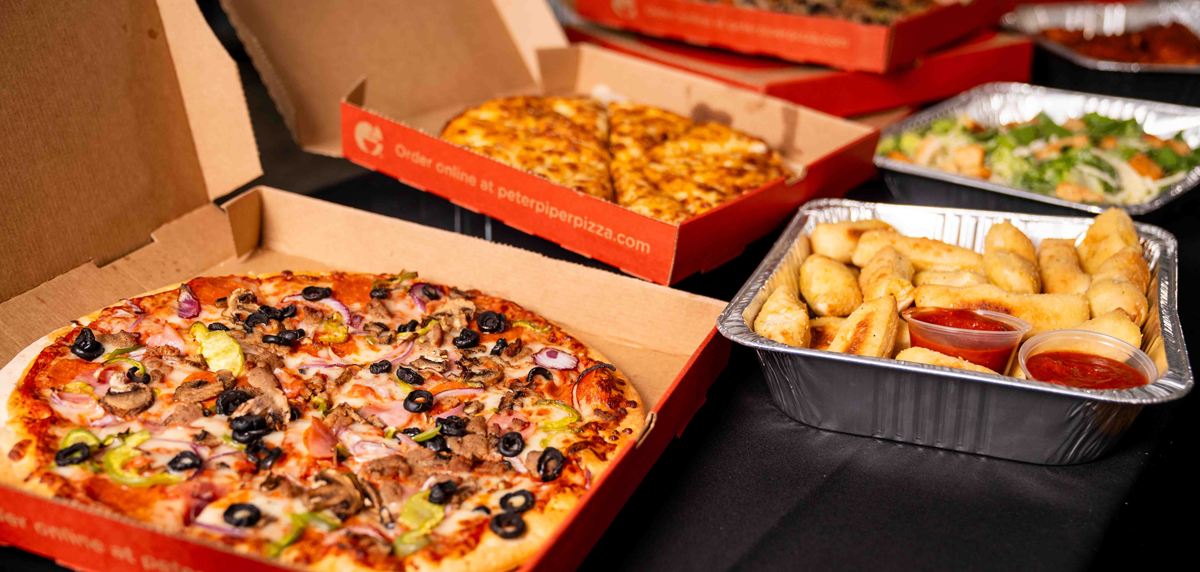
At Peter Piper Pizza, hand-crafted pizzas made with dough made-from-scratch, never frozen and fresh toppings can form the foundation of a catering order. Wings, starters, salads, sides, desserts and drinks can then be added to create a complete spread.
This approach keeps the menu manageable while still giving guests options.
How Much Pizza Should You Order?
A common rule of thumb is to plan for:
- 1 to 2 slices per younger child
- 2 to 3 slices per adult
- 3 or more slices per teenager or especially hungry guest
The exact number of pizzas depends on how many slices come with each size, so confirm the slice count before finalizing a large order.
For example, if you are feeding 30 adults and estimating 2.5 slices per person:
30 guests × 2.5 slices = 75 slices
If each large pizza contains eight slices:
75 ÷ 8 = 9.375 pizzas
Round up to 10 large pizzas.
You may be able to order fewer pizzas if the menu also includes wings, salad, starters, or other filling items.
Add Variety Without Overcomplicating the Order
More options do not always create a better catering experience. Too many choices can make the order more expensive and increase the chance that less-popular items go untouched.
For most groups, a simple mix works best:
- Cheese pizza
- Pepperoni pizza
- One or two specialty options
- Wings
- Fresh salad
- A shareable dessert
The majority of the order should usually be made up of familiar favorites. Specialty options can add variety, but they should not outnumber the items with the broadest appeal.
For example, if you are ordering 12 pizzas, a balanced mix might include:
- Four cheese pizzas
- Four pepperoni pizzas
- Four specialty or combination pizzas
Adjust the mix based on what you know about the group.
Do Not Forget a Lighter Option
Even when pizza and wings are the main attractions, including a lighter choice can make the menu work for more people.
A fresh salad can be helpful for:
- Guests who prefer a lighter meal
- Adults balancing richer menu items
- People who want more variety
- Groups with different appetites
You do not need a large number of separate alternatives. One well-planned lighter option can help the overall spread feel more complete.
- How Many Wings and Sides Do You Need?
Wings and starters can help add variety, but they should usually support the main meal rather than replace it.
A simple approach is to estimate:
- 2 to 4 wings per person when served with pizza
- More if wings are a major part of the meal
- One or two shared starters for smaller groups
- Additional sides for larger gatherings
If the group includes many teenagers, athletes or adults arriving hungry, estimate toward the higher end. For office lunches or mixed-age groups, wings and sides can help satisfy different preferences without requiring a completely separate meal option.
Plan Dessert Separately
Dessert portions are often smaller than main-meal portions, especially after a filling meal.
When planning dessert:
- Estimate one modest serving per guest
- Order slightly less if cake or another dessert is also being served
- Choose something easy to divide and share
- Consider whether the event includes children, adults, or both
A shareable dessert such as Cinnamon Crunch Dessert can provide a simple finish without requiring several individual dessert selections.
Order Slightly More, Not Significantly More
It is usually better to have a little extra food than to run out, but the key word is little.
A reasonable buffer may include:
- One extra pizza for a medium or large group
- A few additional wings
- An extra serving of salad
- A small amount of dessert beyond the expected count
You probably do not need to order 20 percent more food unless the guest count is highly uncertain or the group is known for larger appetites. A small buffer protects against surprises while keeping the order practical.
Match the Order to the Type of Event
Different events call for different catering plans.
Office Lunches and Meetings
For an office lunch, focus on:
- Predictable portions
- Easy serving
- Broadly appealing choices
- Food that can be enjoyed without a long setup
- Enough variety for different preferences
A mix of pizza, wings, salad, and dessert can work well without requiring individual orders.
School Functions
School groups often benefit from:
- Familiar foods
- Simple toppings
- Easy portioning
- Minimal utensils
- A clear plan for children and adults
Cheese and pepperoni pizzas are often the safest foundation.
Team Events
Teams may arrive with larger appetites, particularly after physical activity.
Plan for:
- More slices per person
- Additional wings or sides
- Plenty of drinks
- A little more food than you would for a casual afternoon event
Family Gatherings and Celebrations
Mixed-age gatherings need flexibility.
A balanced spread can include:
- Simple pizzas for children
- Specialty options for adults
- Salad and wings
- Shareable dessert
This allows everyone to build a meal that works for them.
Schedule Larger Orders in Advance
Larger catering orders require more preparation than a typical family meal.
Planning ahead gives the restaurant time to:
- Prepare the correct quantities
- Organize multiple menu items
- Coordinate the requested timing
- Make adjustments if needed
- Ensure the order is ready for the event
Peter Piper Pizza recommends allowing at least 24 hours for most catering orders. Larger events may benefit from additional notice.
Once the order is placed, confirm:
- The guest count
- Menu selections
- Event date and time
- Any requested customizations
- Plates, napkins, and utensils
Catering orders include disposable plates, napkins, and utensils, which can make setup and cleanup easier.
Best For…
Group catering works especially well for:
- Office lunches
- Meetings and training sessions
- Birthday parties
- Family gatherings
- School functions
- Fundraisers
- Team events
- Work celebrations
- Club meetings
- Large group gatherings
The right catering plan gives guests enough to enjoy while keeping the organizer’s job simple.
Frequently Asked Questions
How much catering food do I need per person?
The answer depends on the menu, event time, and guest ages. For pizza, plan for one to two slices per younger child and two to three slices per adult, then adjust based on sides and appetites.
How much food should I order for 25 people?
For a full meal, begin by estimating each guest’s main-item portion and then add shared sides, salad, dessert and drinks. A pizza-based menu may require roughly seven to nine large pizzas, depending on slice count and the amount of other food served.
How do I avoid overordering catering?
Use an accurate guest count, consider the time of day, account for other food being served and add only a modest buffer. Avoid ordering too many specialty items or duplicate sides.
What are the best catering foods for a large group?
Shareable, familiar foods such as pizza, wings, salads, sides and desserts work well because they are easy to serve and can satisfy a range of preferences.
How much variety should a catering menu include?
A few well-chosen options are usually enough. Build most of the order around familiar favorites, then add one or two specialty items and a lighter choice.
How early should I place a catering order?
Most Peter Piper Pizza catering orders can be placed with 24 hours’ notice. Larger events may require more lead time, so contact your local restaurant when planning.
Are plates and utensils included with catering?
Yes. Peter Piper Pizza catering orders include disposable plates, napkins, and utensils for easier serving and cleanup.
Planning Catering for a Group?
The best catering orders are built around a clear guest count, realistic portions, familiar foods, and enough variety to give everyone something they will enjoy.
Peter Piper Pizza catering makes it easy to build a group-friendly spread with hand-crafted pizzas made from dough made-from-scratch and fresh toppings, plus wings, salads, sides, desserts and drinks. With flexible options for groups of all sizes, it can help simplify office lunches, school functions, parties, meetings and celebrations.
You can explore Peter Piper Pizza catering options and contact your local restaurant to begin planning your order.